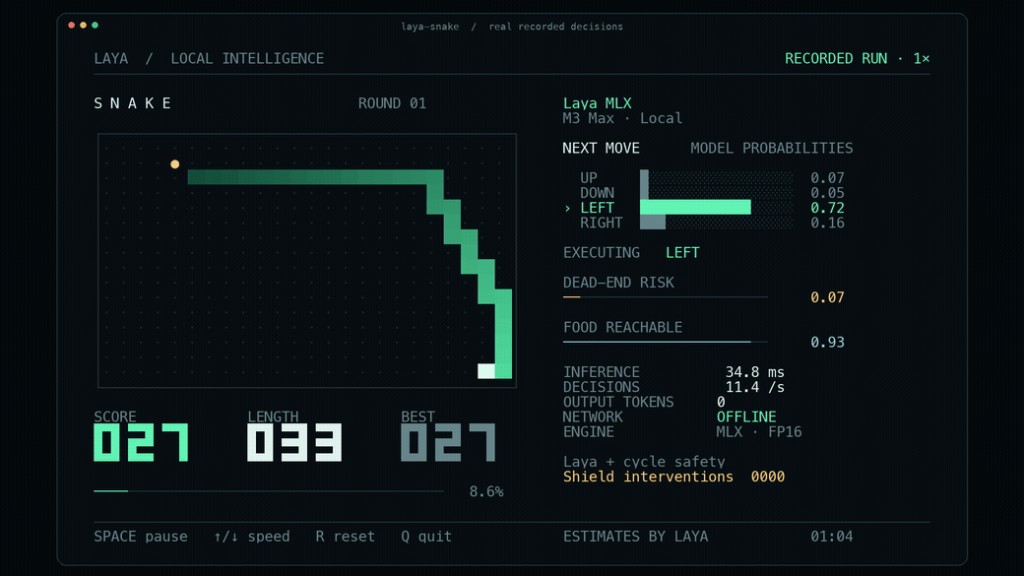
A local Snake loop for Apple Silicon. Each turn asks the MLX build for a direction, and a safety layer can reject a move that would end the run. The repo’s optimized max-speed note reports 75.40 moves per second across 2,400 moves on an M3 Max.
An independent Core ML port of the typed-decision API, with a terminal Snake demo and a short-question path aimed at the Apple Neural Engine. The project describes short decisions at about 5 ms on an M3 Max.
A published comparison of a short multilingual question on an M3 Max. The note reports 4.98 ms p50 for ANE FP16, and about 2.78× lower whole-system energy per decision than compiled MLX FP16 in that same test.
The installable MLX runtime. Its page reports a 13.4 ms median for a short English decision and 7.4 ms for the multilingual checkpoint, with no generated tokens.
Apple Silicon weights for the 322M multilingual checkpoint. The card reports that FP16 matched the upstream argmax on 63 of 63 decision distributions in the author’s local check.
An MLX conversion of the specialist checkpoint, not a new fine-tune. The card reports 63/63 argmax agreement with upstream PyTorch on the author’s fixture set.
A portable Core ML bundle that scores choice, score, and noul questions on Apple Silicon without a PyTorch runtime. The card marks it as an independent conversion.
A short-context Core ML bundle converted from the multilingual checkpoint for CPU plus the Neural Engine. The card includes a Snake command that points this bundle at the local demo.
A float16 ONNX graph of the multilingual checkpoint, including a path for onnxruntime-web. The card reports 63/63 selected-answer agreement with the MLX runtime on its parity fixtures.
A fork of the MLX runtime whose description reports short decisions in the 7–14 ms range on an M3 Max, and which publishes the ONNX export used by the browser demo.
A Metal runtime for Macs that keeps inference on the machine. The repo ships a local Pong demo and more than one memory setting for the same typed-decisions checkpoint.
ConvAI’s own specialist, fine-tuned on four synthetic workflows. The card publishes 0.766 accuracy on 2,000 decisions and says the base checkpoints sit near chance on that same set until they are fine-tuned.
The upstream repository. ConvAI points to a Kaggle notebook, laya_finetune_typed_decisions_2xT4_kaggle.ipynb, for reproducing the specialist checkpoint on free 2×T4 GPUs.
The hub card for all three checkpoints. ConvAI reports 32.8 ms for one multilingual question on a T4, and a slower English checkpoint when the script is not Latin.
The 322M checkpoint ConvAI recommends outside English. Their 51-language sweep is the source for the claim that the English checkpoint can stay confident while reading a script it cannot handle.